The Dwarf 3 Smart Telescope
Another compact smart telescope is the Dwarf 3, shown below Although similar in concept to the Seestar, it reflects a distinctly different design philosophy.
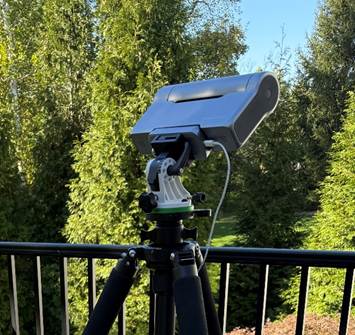
Dwarf 3 smart telescope
The Dwarf incorporates two cameras and can be used not only for deep-sky imaging but also for more general terrestrial observation. Its portability makes it especially suitable for travel or quick backyard sessions.
Like other smart telescopes, focus, alignment, and tracking are handled automatically. Once the target is selected, the system begins capturing exposures and stacking them. Watching the image improve on the display gives a good sense of how integration time affects the result. Some example images produced with the Dwarf 3 are shown in the Dwarf 3 Gallery. Because of its flexibility and compact size, the Dwarf is attractive to observers who want a portable system that can be used frequently without extensive preparation.
Dwarf 3 Details
- It has a 35 mm diameter, 150 mm FL main scope and an equivalent 45 mm FL wide angle scope, each with a camera.
- The main camera resolution is 8.2 Megapixels.
- FOV is about 2.9° × 1.7° in the tele mode.
- Filters: built-in astrophotography filters.
- EQ Mode available with use of a wedge.
- 128 GB internal storage. And
- 10,000 mAh battery
Like the Seestar S50, Dwarf 3 has a full featured app for a smart phone or tablet to allow control and viewing.
Impressions of Dwarf 3:
- The best way to use the scope is by creating an imaging schedule prior to starting for the evening. Just be mindful of the altitude of selected objects at the specified times.
- In the Alt-Az mode, setup is quite simple. Just level the scope and point the cameras to the sky.
- EQ mode requires a few more steps for calibration, but the procedure is directed by the app as you proceed. It does not require visibility of a Celestial Pole.
- Prior to each GOTO, Dwarf 3 does a calibration and autofocus and then does a verification plate solve after the GOTO. Positioning of the targets is right in the center of the frame. EQ mode was also quite easy to setup and calibrate, using an EQ adapter.
- Dwarf 3 excels for large objects, such as Andromeda Galaxy and the NA Nebula.
- Sun and Moon imaging is easy because of the ability to manually center them with the wide camera.
- Tracking over several hours was no problem, even without a separate guide scope, which is possible through the use of plate solving.
 My Astronomy