The Celestron Origin
At the higher end of the smart telescope spectrum is the Celestron Origin, shown below. This instrument is larger and more capable than the compact units like Seestar. Its fast optical design and mount allow it to collect more light quickly and the EQ mode supports longer exposures.
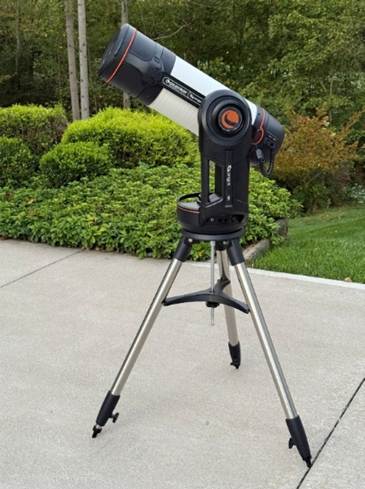
Celestron Origin- Alt-AZ mode
The larger aperture means that faint objects can be recorded with more detail and improved signal-to-noise ratio. For observers who want results closer to those of traditional astrophotography systems, but without having to assembling multiple components—the Origin offers an appealing approach.
Celestron Origin details
- 6” Rowe-Ackermann Schmidt Astrograph (RASA) 335 mm FL optical design, with a fast f/2.2 focal ratio.
- Automated Setup: automatically focuses and aligns itself.
- Sony IMX178 color sensor
- AI image processing: during exposure.
- Easy Target Selection
- GoTo and imaging and tracking
- EQ mode available
- Portability: larger and heavier than other examples
Origin First Night Results & Impressions
While not intended to be a full review, here are some impressions. Imaging began with the default Alt-Az mode. The first night was clear, but with a partial moon, so conditions were not ideal. The session ran from about 9PM to 6AM the next morning. The image acquisitions were a combination of live capture and Planned Sessions. The first image is of M13.
Note: The various hardware discussions are illustrated with first night images, showing what can be accomplished right out of the box.
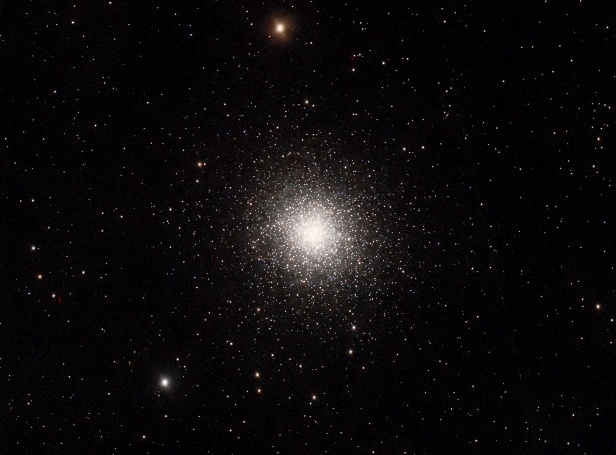
M13 With Origin. Total exposure: 15 minutes (30 x 10 s subframes).
The results were good under the imaging conditions. These images were internally processed by the Origin. Only a bit of brightening in Photoshop was later applied using Levels to ensure the images showed well. With a total of 15 minutes of 10 second exposures, automatically acquired and processed by Origin’s AI routine, the result was quite satisfactory.
While an exposure of 10 seconds per subframe appears to be short for an astro-image, there is the benefit that the subframes are unlikely to have saturated stars.
The next target was M33, the Triangulum Galaxy (M33) with a total exposure of 1.7 hours. Next was the Eastern Veil Nebula (NGC 6992). This was processed in Astro Pixel Processing from Origin raw subframes. Total exposure time was 1.4 hours.
The final image for the night is of M42 , taken at about 5AM, just prior to morning twilight. Total exposure was 45 minutes, again with 10 second subframes.
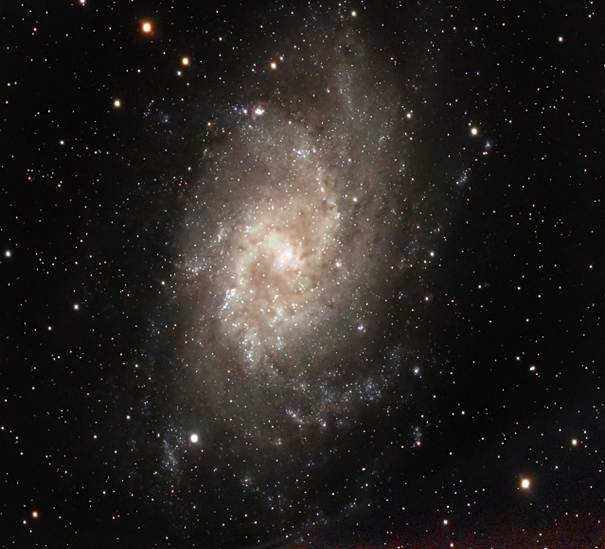
Triangulum Galaxy (M33). Taken with Origin. Total exposure of 1.7 hours
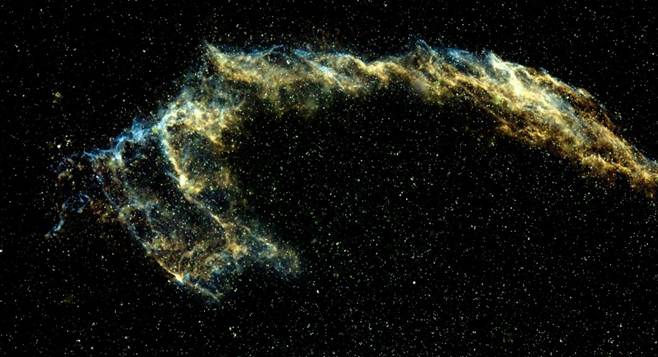
Eastern Veil Nebula (NGC 6992). Taken with Origin. Total exposure : 1.4 hours (512 x 10 s subframes).
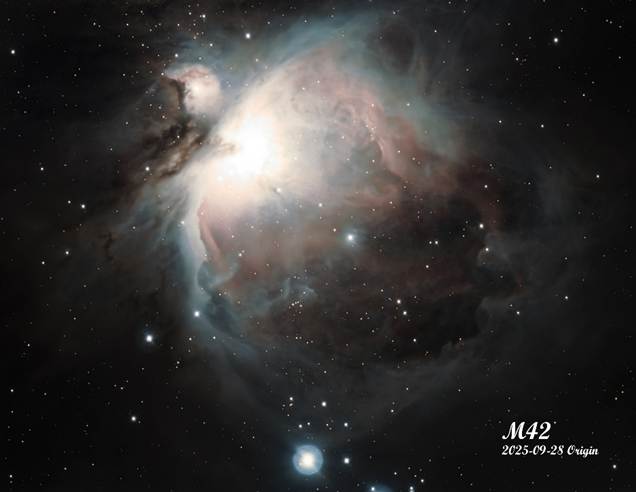
Great Nebula in Orion (M42). Processed by Orion’s AI routines. Total exposure: 45 minutes
These images clearly show that the Origin smart telescope is capable of nice results with not much of a learning curve, taken from a site with modest viewing conditions.
To achieve the image quality of the internally processed images, Celestron has integrated AI based proprietary processing routines for noise reduction, deconvolution to reduce star size, and a process to remove image gradients caused by light pollution, etc. To compensate for Alt-Az rotation the final image is automatically cropped to remove the outer portions of the rotated frames. These AI routines enhance existing details and reduce image noise. No data are added. The AI models have been trained with Origin images and the models are specifically tailored to Origin technical attributes, such as camera noise, OTA focal length, and so on. In addition, all the raw-frame processing takes place in the 10 seconds of normal Alt-Az exposure time.
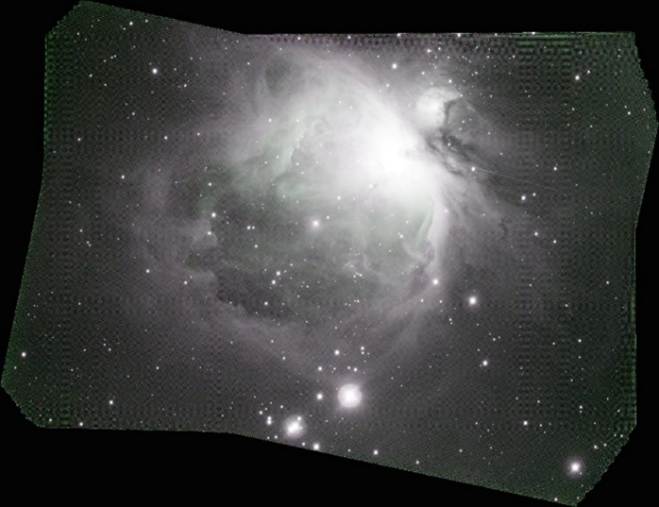
Field Rotation caused by Alt-Az Mount. M42 stack processed in AP. No crop.
Effectiveness of Origin’s AI Processing
To evaluate Origin’s AI processing effectiveness, the raw images from M42 were also externally processed with AstroPixel Processor, using the Origin provided Darks and Flats. The resulting AP processed image is shown aboveuncropped Note the effect of Alt-Az mount image rotation in the outer portions of the image.
To illustrate the AI processing effectiveness, a portion of the M42 AI-enhanced stacked image versus the stacked image externally processed from the raw subframes is shown. The Raw-derived image has greater noise and the stars are larger and less sharp. Because the AI processing takes place in real time within the Origin processor on each raw frame prior to stacking, the Origin AI routines can only be applied during subframe capture. Finally, the final externally processed image is presented.
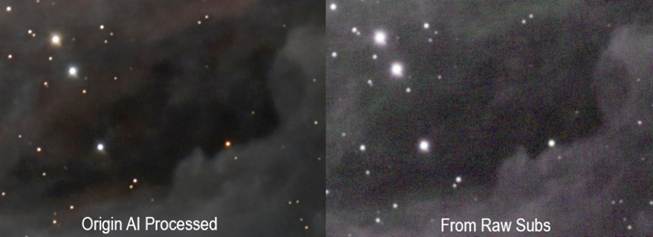
Origin AI Processed (left) vs externally processed (right) raw.
Origin on EQ Wedge
With Origin mounted on the optional equatorial wedge, the problem of image rotation is solved, and longer subframe exposures are possible. In addition, combining images into a mosaic is easier with minimal image rotational shift between adjacent segments of the mosaic.
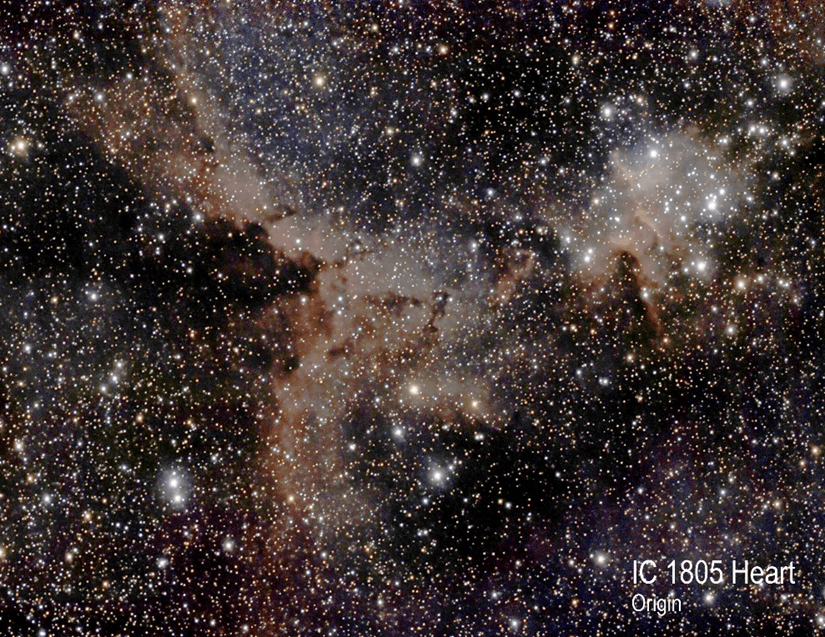
An example from Origin in the EQ mode follows, which is the Heart Nebula (IC1805). The Heart Nebula was exposed for 180 minutes, at 30 seconds for each subframe.
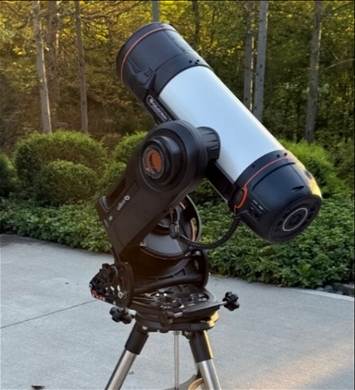
Origin. On optional EQ wedge
Images taken with the Celestron Origin smart telescope
 My Astronomy